Home › Sitework and Structural Concrete
We handle sitework and structural concrete in San Antonio, TX for commercial and industrial projects. Our capabilities include equipment pads, piers, retaining walls, and structural slabs that support heavy loads and complex facilities. With experienced crews and attention to engineering details, we help your project stay on schedule and within spec.
Premier Concrete San Antonio provides professional structural concrete throughout San Antonio, TX, Texas and the surrounding area. Our licensed, insured crew delivers safe, clean, on-time work with a free estimate before anything begins. Call (210) 794-7500 or request your free quote.
Sitework and structural concrete that fits San Antonio soil and codes
Sitework and structural concrete are the parts of your project that everything else depends on. When Premier Concrete San Antonio comes in, our first focus is how your soil, drainage, and structure will work together for decades in our local climate. That means checking your site for caliche layers, clay pockets, and slope, not just showing up with a mixer.
Most of our structural concrete work in San Antonio falls into a few categories: foundations for new homes and additions, grade beams and piers, structural slabs for shops and metal buildings, elevated decks and stairs, retaining walls, and structural flatwork that carries real loads, like driveways for heavy trucks or RVs. On the commercial side we often pour structural concrete for tilt-wall buildings, equipment pads, dumpster enclosures, and load-bearing walls. Every one of these needs a different mix design, reinforcement layout, and forming approach.
We work closely with local structural engineers or your chosen engineer to make sure rebar size, spacing, and concrete strengths meet current City of San Antonio and Bexar County requirements. Typical structural mixes here run 3,000 to 4,000 psi for residential and 4,000 to 5,000 psi for commercial. We can also handle higher strength or specialty mixes when a design calls for them, such as for industrial equipment pads or post-tensioned slabs.
Because we work only in this area, we are used to tying our work into the existing housing stock, from 1950s pier-and-beam homes inside Loop 410 to newer slab-on-grade houses in Stone Oak, Alamo Ranch, and the Far West Side. Matching slab elevations, tying new grade beams into old foundations, and managing drainage between neighbors are everyday tasks for our crews.
How sitework actually gets done: excavation, grading, and drainage
On a typical structural concrete project, the sitework sets the tone. First, Premier Concrete San Antonio reviews your survey, drawings, and any soil report you have. If you do not have a soils report, we walk the site with you, probe the ground, and look at nearby structures for signs of movement or poor drainage. This helps us flag risks early, like expansive clay that may need extra undercut or select fill.
Excavation is next. For slab-on-grade projects we strip organics like grass and topsoil, then cut down to design subgrade. For foundations on sloped lots, we bench or step the pad instead of just piling up fill, which helps control settlement. Where plans call for deeper structural beams or piers, we dig or drill to the specified depth and diameter, then clean the holes so there is no loose material that could weaken the concrete bond.
Grading and drainage are critical in San Antonio because of our heavy downpours. We shape the site so water flows away from structures and does not run toward your house, garage, or neighbor. This usually means at least a 2 percent slope away from foundations, swales or channels between buildings, and enough drop to the street or drainage easement. On commercial or multifamily properties we coordinate with the civil drawings so elevations match driveways, parking, and ADA routes.
If the soils are soft, saturated, or full of organics, we undercut and replace with compacted select fill or crushed limestone base. We compact in thin lifts and test with a plate compactor or proof-rolling. This step costs a bit more upfront but is far cheaper than dealing with structural cracks or slab settlement after the building is finished.
Formwork, reinforcement, and concrete placement for structural strength
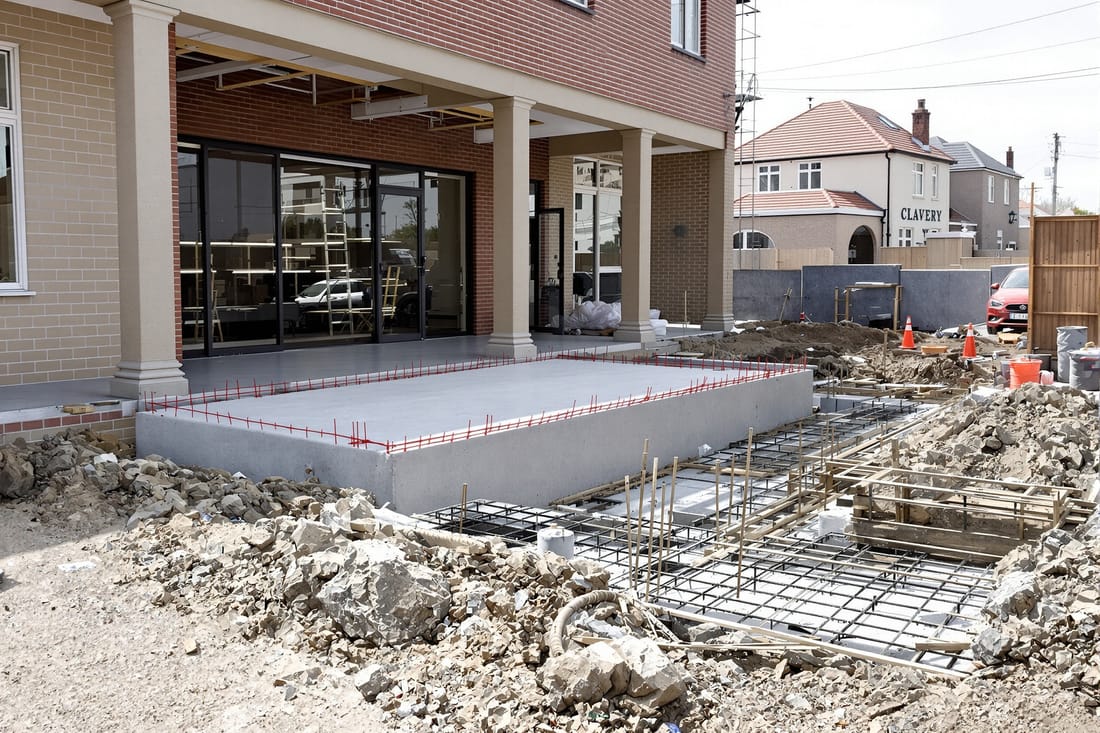
Once the ground is right, we move to forming and reinforcing. Premier Concrete San Antonio sets forms to the engineer’s dimensions and checks elevations with a builder’s level or laser. For structural slabs we hold tight tolerances so doors, framing, and finishes fit without expensive shimming later. On retaining walls and grade beams we brace forms to handle the weight of wet concrete and vibration during placement.
Rebar installation is where many failures start if contractors cut corners. We use chairs and spacers to maintain proper cover over steel instead of letting rebar sit in the dirt. For footings and grade beams we tie continuous bars around corners, lap splices to engineered lengths, and keep dowels aligned where walls, columns, or masonry will attach. On suspended slabs or decks we often use two layers of steel with proper bar supports so the top mat stays at design height.
For structural concrete mixes, we order from local batch plants with documented strength and slump. We confirm truck tickets on site and watch how the mix handles as it comes down the chute. We do not add water to the truck to make it easier to work because that reduces strength and increases cracking. Instead, if needed, we have the plant adjust the mix with an approved plasticizer in the correct ratio.
Placement and finishing are timed to the weather. In the summer heat we schedule earlier pours, use cure agents, and may set up wind breaks or shade in exposed areas so the concrete does not dry too fast. During cool or damp periods, we adjust set times and finishing techniques so the surface is not closed up over too-wet concrete. For critical structural elements like columns, walls, and heavily reinforced beams, we vibrate the concrete to remove air pockets and ensure full consolidation around the steel.
Costs, options, and what affects price for structural concrete
The cost of structural concrete and sitework in San Antonio depends on more than just square footage. The main drivers are soil conditions, access, reinforcement requirements, concrete strength, and finish details.
Soils that need undercut and replacement, extra thickened edge beams, or deep drilled piers will increase cost, but they also protect your building from the settlement and heaving we see in local clay pockets. Access matters because tight lots in older areas like Beacon Hill or Monte Vista often require smaller equipment and more hand work, which takes longer than working on a wide-open lot outside Loop 1604.
Rebar and concrete strength are usually set by the engineer, but there are sometimes options. For example, a detached garage slab that will carry a heavy truck might use a thicker slab with more rebar in a standard strength mix, instead of an extremely high-strength mix with less steel. We walk you through these options and explain the long-term tradeoffs so you are not just choosing by the lowest upfront price.
Finish and complexity also play a role. A plain broom-finished structural slab will cost less than a structural deck with formed edges, integrated stairs, and multiple elevation changes. Retaining walls that are simply backfilled are cheaper than those that also need waterproofing, weep holes, and decorative facing. On commercial projects, adding embedded anchor bolts, blockouts, and conduit in the concrete adds labor but can save time and drilling costs later.
Premier Concrete San Antonio provides line-item estimates that separate excavation, base, forming, rebar, concrete, and finishing. This transparency helps you compare bids accurately. If another quote looks much cheaper, we can help you check whether it includes the same reinforcement, thickness, and sitework, or if something critical has been left out.
Common problems in San Antonio structural concrete and how we prevent them
Local conditions create a predictable set of problems in structural concrete around San Antonio, and we plan for them from day one. The most common issues are cracking from poor subgrade or thin slabs, movement from expansive clay, drainage failures that put water against foundations, honeycombing in walls or beams, and rebar corrosion from inadequate cover or poor waterproofing.
To reduce cracking and movement, we follow the engineer’s details for slab thickness, beam depth, and reinforcement pattern, and then pay close attention to subgrade prep and compaction. We also use saw-cut control joints or tooled joints early in the cure so any unavoidable shrinkage cracks form where they are least visible and least harmful. On long structural runs like commercial walkways and drive lanes, we plan joint spacing that fits both the structural design and the layout of the building.
For drainage-related issues, we are careful with final grading. We do not leave you with a flat yard that holds water along the foundation. Instead, we match door thresholds, driveway slopes, and yard elevations so water has a clear path away. Where retaining walls or below-grade structures are involved, we install gravel backfill, perforated drain lines, filter fabric, and weep holes as shown on the plans so pressure and water do not build up behind the wall.
Quality control continues after the pour. We watch for early signs of surface problems, such as blistering, scaling, or plastic shrinkage cracking, especially in hot, windy weather. When needed, we adjust curing methods using curing compounds, light water fogging, or coverings to hold in moisture for the first few days. For larger projects, we can coordinate cylinder tests and inspection reports with your engineer so you have documentation of the concrete strength before heavy loads are placed.
For property owners, the main thing to know is that structural concrete fails most often because of what you cannot see: poor prep, rushed reinforcement, or skipped steps in drainage. At Premier Concrete San Antonio, our crews spend the bulk of their time on those “invisible” tasks. That is how we keep slabs, walls, and foundations performing in San Antonio’s heat and storms long after the project is finished.